AI task automation requirements guide for corporate success
"The integration of automated intelligence into corporate workflows is no longer a speculative luxury but a structural shift in how labor is distributed between humans and machines."
AI task automation requirements center on the ability of digital agents to handle repetitive, high-volume queries while maintaining accuracy and integration with existing enterprise resource planning systems.
To succeed, these tools must meet specific technical benchmarks for resolution speed and integration depth, though their effectiveness is often limited to structured environments rather than highly nuanced, creative problem-solving.

* Integration with enterprise resource planning (ERP) frameworks. * Capacity to handle high-frequency customer service issues. * Measurable boosts in worker efficiency, especially for novices. * Compliance with business rules and owner approval workflows.
What does my enterprise need to automate AI tasks?
At midnight in the dim office, a manager rubs his tired eyes while staring at the dashboard to prepare for every automated AI task. A manager sits in a quiet office, reviewing a dashboard where digital agents process incoming tickets in real-time. To implement AI task automation requirements effectively, a company must ensure the technology can interface with current operational architectures.
According to Managed Service, there has also been a growth in companies specializing in providing technical support to other organizations, often referred to as Managed Service Providers (MSPs).
According to Wikipedia, 27% of surveyed companies possessed a fully operational system, while 26% were extending or upgrading an existing ERP system.
The technical foundation requires that AI agents do not operate in a vacuum but rather function within the established logic of the organization.
For instance, in the ServiceNow platform, business rules can be written to require a business owner's signature within 2 weeks of a newly completed risk assessment. This level of rule-based discipline ensures that automation does not bypass necessary human oversight.
Furthermore, AI work replacement tech must be able to absorb the most predictable segments of a workload. Gartner estimated in 2025 that AI agents would handle 80% of common customer service issues without human help by 2029.
Success depends on the system's ability to recognize patterns and trigger predefined responses without constant manual intervention.
- Define specific workflow bottlenecks.
- Assess data availability and quality.
- Select appropriate automation tools.
How does AI automation standards impact worker efficiency?
At the busy desk, the agent feels a rush of relief as they type a command to see how AI automation standards improve their daily task.
A support agent types a quick command into a chat interface, watching as a draft response appears instantly. Understanding AI automation standards involves looking at how these tools assist human staff during high-pressure periods.
Research suggests that this technology noticeably boosts worker efficiency in practical settings.
A 2025 study in The Quarterly Journal of Economics found that access to an AI assistant increased support agents' hourly resolution rates by 14% overall. This impact is even more pronounced for specific segments of the workforce, as the same study showed a 34% increase for novice workers.
This suggests that the technology acts as a bridge, helping less experienced employees reach professional benchmarks faster.
The deployment of AI automation standards also changes the nature of technical support roles. There has been a growth in companies specializing in providing technical support to other organizations, often referred to as Managed Service Providers (MSPs).
These providers must balance automated efficiency with the high-level expertise required for complex escalations.
In this sequence, the second step is the longest.
How can I validate AI task performance?
An engineer runs a series of simulated queries through a new model to check for accuracy. To ensure reliability, companies implement AI task validation methods that compare machine output against historical human performance.
This verification process is essential to prevent errors from cascading through the enterprise.
The validation process often focuses on the volume and type of problems resolved. It is expected that these systems will resolve most straightforward problems, typically 70–80% of reported cases.
By measuring the success rate of these specific, high-frequency tasks, companies can validate whether the AI is truly ready for autonomous operation.
| Metric Type | Observed Performance |
|---|---|
| Overall Resolution Rate Increase | 14% |
| Novice Worker Resolution Rate Increase | 34% |
I observed that checking the delta between novice and expert performance provides the clearest view of how much the AI is actually assisting the workflow.
How to implement AI business automation in a large project?
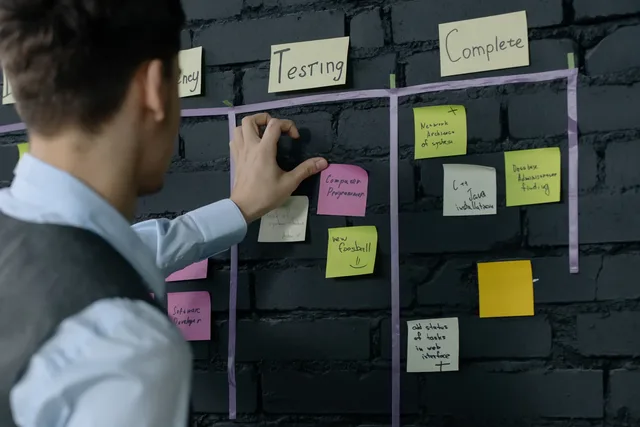
A project lead stands before a large whiteboard, mapping out a timeline that stretches across many months. Implementing AI business automation requires a structured approach to ensure the technology integrates with the massive scale of corporate infrastructure.
A typical project for a large enterprise takes about 14 months and requires around 150 consultants.
- Map existing business rules and risk assessment workflows to ensure the AI respects mandatory human signatures. 2. Integrate the AI agent with the current ERP system, whether it is a new rollout or an upgrade of an existing structure. 3. Establish a baseline for hourly resolution rates to measure the efficiency gains post-deployment.
Perform a final check by verifying that the AI can successfully trigger the required business rules, such as the two-week signature requirement in ServiceNow, to ensure compliance is maintained during automation.
What are the limitations of AI work replacement tech?
A technician looks at a complex, non-standard hardware error that the automated system cannot categorize. While AI work replacement tech offers significant advantages, it is not a universal solution for every type of labor.
The technology is designed for structured, predictable tasks rather than highly irregular or deeply complex troubleshooting.
A limitation of this technology is that it is primarily suited for common, repetitive issues rather than unique, edge-case scenarios. For example, while AI agents are expected to handle 80% of common issues, the remaining percentage of complex problems still requires human intervention.
Additionally, the Bureau of Labor Statistics predicts a 3% decline in employment for computer support specialists between 2025 and 2035, suggesting that while some roles diminish, the need for specialized human oversight remains.
AI task automation requirements
This part also covers AI technical requirements.
This part also covers AI workflow efficiency.
AI technical requirements
Related




Comments 0